
Adaptive Bitrate Streaming Explained: How It Keeps Your Video Playing Smoothly
Adaptive bitrate streaming automatically adjusts video quality in real time to match a viewer's network conditions, reducing buffering and keeping playback smooth across devices.
If you have ever watched a video online and noticed it looks a bit blurry for a few seconds before sharpening up, or if your stream never seems to buffer even on a shaky connection, you have adaptive bitrate technology to thank. This behind-the-scenes process is one of the most important innovations in modern streaming, yet most viewers have no idea it exists. In this article, we will break down what adaptive bitrate streaming is, how it works, and why it matters for anyone who watches or creates video content online.
What Is Adaptive Bitrate Streaming?
Adaptive bitrate (ABR) streaming is a method of delivering video content that automatically adjusts the quality of the stream based on a viewer's current network conditions and device capabilities. Instead of sending one fixed version of a video file, the streaming service prepares multiple versions of the same content at different resolutions and bitrates. As you watch, your device continuously communicates with the server to select the best possible version in real time.
This means that if your internet connection suddenly slows down, perhaps because someone else in your household starts a large download, the stream can drop to a lower resolution to avoid buffering. When your connection improves, the quality ramps back up. The goal is to keep the video playing continuously, even if that means temporarily sacrificing picture quality.
How Adaptive Bitrate Technology Works
At a technical level, adaptive bitrate streaming relies on a process called transcoding. When a video is uploaded or broadcast, the streaming platform encodes it into several different quality tiers, often ranging from low resolution options suited for weak connections to high definition or even 4K versions for fast, stable networks. Each of these versions is broken into small segments, typically a few seconds long.
The video player on your device, whether that is a smart TV app, a web browser, or a mobile app, measures your available bandwidth and device performance. Based on this ongoing measurement, the player requests the next segment from the quality tier that best matches your current conditions. Because switching happens between short segments rather than mid-stream, the transition is usually smooth and barely noticeable.
Two of the most common protocols that enable this are HLS (HTTP Live Streaming) and MPEG-DASH (Dynamic Adaptive Streaming over HTTP). Both rely on the same fundamental idea of segmenting content into multiple quality levels, but they differ in technical implementation and platform support.
Why Adaptive Bitrate Matters for Viewers
For everyday viewers, adaptive bitrate streaming is largely invisible, which is exactly the point. A well-implemented ABR system means fewer interruptions, less buffering, and a generally more reliable viewing experience across a wide range of devices and network conditions. Whether you are streaming on a fiber connection at home or watching on mobile data during a commute, ABR helps ensure the video keeps playing.
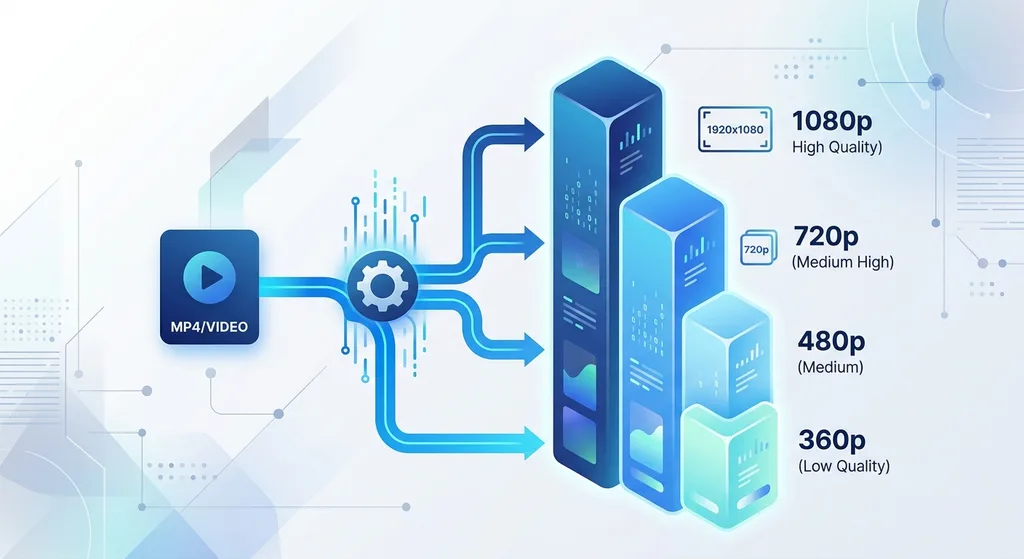
This technology has become especially important as viewing habits have diversified. People now watch content on phones, tablets, laptops, smart TVs, and gaming consoles, often switching between networks throughout the day. Without adaptive bitrate streaming, creators and platforms would need to choose a single quality level that compromises for the lowest common denominator, resulting in either frequent buffering for users with weaker connections or unnecessarily low quality for those with strong ones.
Why It Matters for Creators and Streamers
If you are on the broadcasting side, understanding adaptive bitrate is just as valuable. Many streaming platforms and encoder tools now offer built-in support for multi-bitrate output, allowing your content to reach a broader audience regardless of their connection quality. Setting this up correctly can mean the difference between retaining viewers through a rough patch of network congestion or losing them to buffering frustration.
For those just getting started with live broadcasting, learning how encoder settings, resolution, and bitrate interact is a foundational skill. If you want a deeper walkthrough of the setup process, our complete online streaming tutorial covers everything from choosing encoder software to configuring these settings step by step.
Common Misconceptions About Adaptive Bitrate
One frequent misunderstanding is that adaptive bitrate streaming is the same as simply offering a manual quality selector, like the gear icon on many video players that lets you pick 480p, 720p, or 1080p. While related, these are not identical. Manual selection gives control to the viewer, while true adaptive bitrate streaming happens automatically and continuously in the background, often switching multiple times during a single viewing session without any input from the user.
Another misconception is that ABR guarantees a perfect experience regardless of connection. In reality, if your network drops below the lowest available bitrate tier, you may still experience buffering. Adaptive bitrate reduces the frequency and severity of these interruptions, but it cannot eliminate the fundamental requirement of having some baseline level of connectivity.
The Evolving Landscape of Streaming Technology
Adaptive bitrate streaming continues to evolve alongside broader advances in video compression, network infrastructure, and artificial intelligence driven optimization. Newer codecs are making it possible to deliver higher quality video at lower bitrates, which in turn improves the effectiveness of ABR systems. Some platforms are also experimenting with predictive algorithms that anticipate network changes before they happen, rather than simply reacting to them.

These developments are part of a much larger wave of innovation reshaping how content is delivered and consumed. For a broader look at what is changing across the industry, check out our roundup of media tech breakthroughs reshaping the streaming industry in 2025.
Choosing Platforms with Strong Adaptive Bitrate Support
Not all streaming services implement adaptive bitrate technology equally well. Some platforms invest heavily in robust multi-bitrate infrastructure and content delivery networks, while others offer a more limited experience. If smooth, uninterrupted playback is a priority for you, it is worth considering how different services perform in this area when deciding where to spend your subscription dollars. Our guide to the best streaming platforms in 2025 can help you compare your options.
Conclusion
Adaptive bitrate streaming is one of those quiet technologies that makes modern video consumption feel effortless. By automatically adjusting quality to match network conditions in real time, it allows viewers to enjoy continuous playback across an enormous range of devices and connection speeds. Whether you are a casual viewer or an aspiring streamer, understanding how this technology works can help you make more informed choices about the platforms and tools you use. As compression technology and network infrastructure continue to improve, adaptive bitrate streaming will likely become even more seamless, further closing the gap between the content creators produce and the experience viewers receive.
Editorial Team
Frequently asked questions
What is adaptive bitrate streaming?
Adaptive bitrate streaming is a technology that automatically adjusts the quality of a video stream in real time based on a viewer's network speed and device performance, helping to minimize buffering.
Is adaptive bitrate the same as manually changing video quality?
No. Manual quality selection is controlled by the viewer, while adaptive bitrate streaming happens automatically in the background without requiring any input from the user.
Can adaptive bitrate completely eliminate buffering?
Not entirely. It significantly reduces buffering by adjusting to available bandwidth, but if your connection drops below the lowest supported quality tier, interruptions can still occur.
What protocols are commonly used for adaptive bitrate streaming?
Two widely used protocols are HLS (HTTP Live Streaming) and MPEG-DASH (Dynamic Adaptive Streaming over HTTP), both of which deliver video in segmented, multi-quality formats.
Discussion
Join the conversation
Share your perspective and connect with other readers.